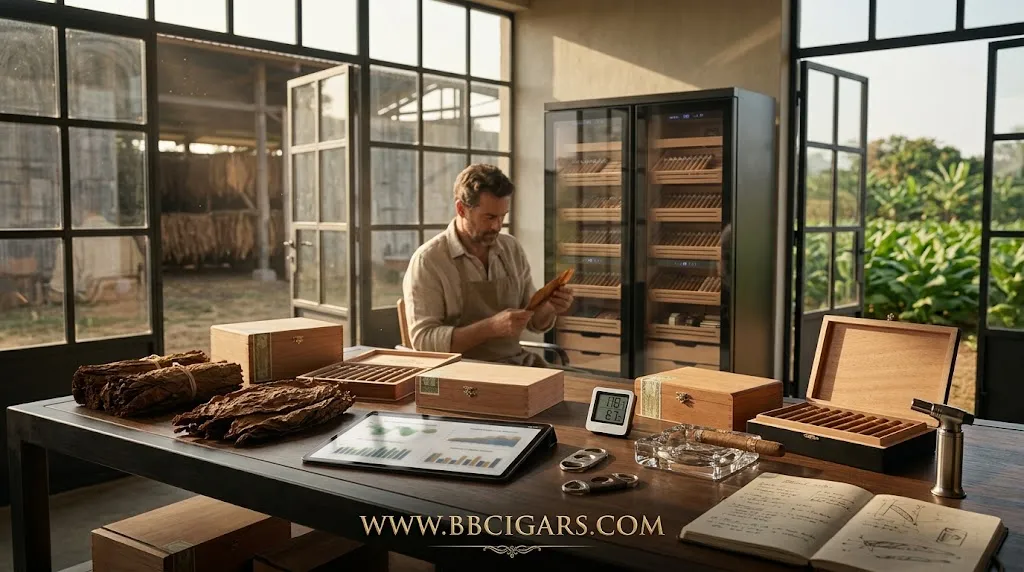
The premium cigar industry is changing in ways that go beyond new releases and seasonal trends. Consumer expectations are evolving, established producing regions remain influential, boutique brands continue to emerge, and international trade is becoming an increasingly important part of the business.
At the same time, premium cigars are becoming more global. Tobacco may come from several countries, a cigar can be developed for a specific international market, and brands are increasingly connecting with consumers through education, events and digital content.
In 2026, several developments provide a clear picture of how the premium cigar industry is changing.
1. The Industry Is Moving From Rapid Growth Toward a More Mature Market
The U.S. premium handmade cigar market provides one of the clearest examples of this transition.
According to data from the Cigar Association of America reported by Cigar Aficionado, approximately 199.5 million premium handmade cigars were imported into the United States during the first half of 2026, compared with 200.5 million during the same period in 2025.
While imports were broadly flat, the overall market remains much larger than it was several years ago. In 2025, U.S. imports reached approximately 429.8 million premium handmade cigars, marking the fifth consecutive year above 400 million units.
This suggests that the industry is moving away from extraordinary pandemic-era growth and toward a more mature market where product quality, brand identity, distribution and consumer loyalty become increasingly important.
2. Nicaragua Continues to Influence Global Premium Cigar Production
Nicaragua remains one of the most important forces in the premium cigar industry.
During the first six months of 2026, Nicaragua shipped approximately 121.6 million premium handmade cigars to the United States, representing about 60.1% of total U.S. imports.
Although the figure was slightly lower than the same period in 2025, Nicaragua remained clearly ahead of the other major producing countries.
Its influence extends beyond production volume. Regions such as Estelí and Jalapa have become closely associated with modern premium cigar manufacturing, while Nicaraguan tobacco is widely used in blends developed for consumers around the world.
The growth of Nicaragua has also helped establish the New World cigar industry as an important part of the global premium cigar landscape.
3. Honduras Is Becoming an Important Growth Story
Honduras is another important example of how the competitive landscape is changing.
During the first half of 2026, Honduran premium handmade cigar shipments to the United States reached approximately 37.5 million units, an increase of about 10% compared with the same period in 2025.
Honduras accounted for approximately 18.8% of U.S. premium handmade cigar imports during the period.
The country’s performance highlights the continued strength of Central America as a major center for premium cigar manufacturing.
For consumers, it also means that the range of New World cigar styles continues to expand beyond the dominant Nicaraguan market.
4. Global Blending Is Changing How Cigars Are Developed
One of the most important long-term changes in premium cigar production is the increasing use of tobacco from multiple origins within a single blend.
A modern cigar may combine filler tobacco from Nicaragua, a binder from another country and a wrapper grown in Ecuador, Mexico or the Dominican Republic.
This approach allows master blenders to select individual tobacco components based on aroma, sweetness, spice, strength, texture and combustion characteristics.
As a result, consumers are increasingly exploring cigars based on their blend composition rather than simply their country of manufacture.
For cigar enthusiasts, understanding the wrapper, binder and filler can provide a much deeper understanding of a cigar’s character.
5. Consumers Are Becoming More Knowledgeable
The way people discover and evaluate premium cigars is also changing.
Specialist websites, social media, online communities and educational content have made information about tobacco and cigar production more accessible than ever.
Consumers can now research tobacco origins, factory locations, vitolas, fermentation, aging and blend composition before purchasing a cigar.
This has increased the importance of transparent product information and educational content for premium cigar retailers.
A strong cigar brand today is increasingly expected to explain not only what a cigar is, but also where its tobacco comes from and how it was made.
6. Brand Storytelling Is Becoming More Important
Premium cigars have always been connected to tradition and craftsmanship, but brand storytelling is becoming increasingly important in a digital marketplace.
Established brands can draw on decades of history, while boutique producers often build their identity around founders, farms, master blenders and specific production philosophies.
Cohiba provides a major example in 2026 as the brand celebrates its 60th anniversary. Habanos has announced a series of anniversary activities, including the worldwide presentation of Cohiba Talismán in London on October 7, 2026.
The 26th Habano Festival itself will not take place in 2026, but the Cohiba anniversary program will continue.
This demonstrates how heritage remains an important part of the premium cigar business even as the market becomes more modern and international.
7. Boutique Brands Are Adding More Diversity
The premium cigar market is no longer defined only by its largest established companies.
Boutique manufacturers have created new opportunities for experimentation, including small-batch blends, unusual tobacco combinations, special formats and limited-production releases.
Smaller brands can often respond quickly to niche consumer interests, while larger companies benefit from established distribution networks and international recognition.
The result is a market with multiple levels of competition rather than a single dominant business model.
8. Limited Editions Are Becoming Part of the Premium Experience
Limited-edition cigars continue to play an important role in the premium segment.
Limited releases allow manufacturers to experiment with rare or specially aged tobacco, distinctive formats and exclusive packaging while creating a stronger sense of scarcity.
For collectors and experienced smokers, the appeal may extend beyond the cigar itself to the story behind the release, its production quantity and its place within a brand’s history.
This connects the premium cigar market with broader luxury trends, where craftsmanship, provenance and scarcity can become important parts of the consumer experience.
9. International Trade Is Having a Greater Impact
One of the biggest changes affecting the premium cigar business is the increasing importance of international trade policy.
In 2026, U.S. tariff policies affecting major cigar-producing countries have gone through several stages. The Premium Cigar Association’s August 2026 summary lists current Section 301 rates of 12.5% for Nicaragua and the Dominican Republic and 10% for Honduras as of August 1, 2026.
Trade measures can influence landed costs, distributor margins, inventory planning and consumer pricing.
For an industry whose production and distribution networks cross multiple borders, changes in trade policy can therefore become part of everyday business decisions.
10. Asia Is Playing a Larger Role in the Global Industry
The premium cigar industry is also becoming more geographically diverse.
Asia is receiving increasing attention from manufacturers, distributors, retailers and industry organizations.
The Premium Cigar Association’s PCA Connect Asia is scheduled for December 4–6, 2026, in Hong Kong. The event will bring together manufacturers, distributors, retailers, duty-free operators, hospitality professionals and other members of the international cigar community.
Participating brands include Plasencia Cigars, Joya de Nicaragua, Eiroa Cigars, Confidenciaal Cigars, Great Wall Cigars and Los Amigos Cigars.
The development reflects a broader shift toward international networking, distribution and consumer engagement.
11. Digital Content Is Changing How Brands Connect With Smokers
Another important change is the growing role of digital content.
Cigar brands and retailers can now communicate directly with consumers through websites, social platforms, videos, newsletters and educational articles.
This has changed the relationship between brands and cigar enthusiasts. Instead of relying entirely on traditional retail channels, consumers can learn about a cigar before entering a store or placing an order.
For premium cigar businesses, this makes content quality increasingly important. Reviews, cigar guides, tobacco education, industry news and production stories can all contribute to a stronger relationship with customers.
12. The Industry Is Becoming More International
Perhaps the clearest overall change is the internationalization of the premium cigar industry.
A single cigar may involve tobacco grown in several countries, blending expertise from another region, manufacturing in Central America and distribution through several international markets.
Brands are also increasingly developing products and marketing strategies for specific regions rather than treating the global market as one uniform audience.
Industry events such as PCA Connect Asia demonstrate this broader movement toward international cooperation and market development.
What These Changes Mean for Cigar Enthusiasts
For cigar enthusiasts, these changes create a much broader world to explore.
The modern premium cigar market offers an increasing variety of tobacco origins, blend styles, vitolas, brands and production philosophies.
Consumers can explore traditional Cuban heritage, the strength and diversity of New World cigars, boutique manufacturers and increasingly sophisticated international blends.
Understanding these changes can also make cigar selection more interesting. Instead of choosing only by brand, smokers can consider tobacco origin, wrapper, binder, filler, aging, format and the story behind the blend.
Final Thoughts
The premium cigar industry is not changing in just one direction.
It is becoming more mature in major markets, more international in its supply chains, more diverse in its brands, more transparent in its product information and increasingly connected through digital media.
At the same time, tradition remains central. Tobacco-growing regions, handmade production, master blending and brand heritage continue to define what makes a premium cigar different from an ordinary tobacco product.
For BB Cigars, following these changes is part of understanding the world behind premium cigars. The industry is evolving, but its core connection to tobacco, craftsmanship and cigar culture remains.
BB Cigars — Premium Cigars, Cigar Culture & Global Industry Insights.